
Learning from the Temptations of Christ
Three of the four gospel accounts refer to Jesus being led by the Spirit into the wilderness to be tempted by the devil. Mark’s gospel gives a very brief summary of this event, making it clear that this took place immediately after Jesus’ baptism when the voice from heaven declared, “You are My beloved Son, in whom I am well pleased” (Mk. 1:11-12). Mark makes no mention of Jesus’ forty-day fast or any of the specific temptations—only that He “was tempted by Satan, and was with the wild beasts; and the angels ministered to Him” (vs.13). The accounts by Matthew (4:1-11) and Luke (4:1-13) reveal three of Satan’s enticements near the end of this ordeal, as well as Jesus’ responses to His adversary.
We should not think that the three specific temptations recorded constituted the totality of Satan’s attacks during those forty days, nor should we think that Jesus was free from temptations after this. Satan merely left Him “until an opportune time” (Lk. 4:15). From the book of Hebrews we learn that, as a man, He “was in all points tempted as we are, yet without sin” (Heb. 4:15).
Though the apostle John did not include this event in his account of the life of Jesus, many sermons have been preached noting that the three temptations in the wilderness seem to correspond well with John’s descriptions of “all that is of the world.” He identifies three worldly desires we all face: “The lust of the flesh, the lust of the eyes, and the pride of life” (1 Jn. 1:15-17). The thought is that every sin begins as a temptation to yield to one or more of these three human desires in a way not authorized by God.
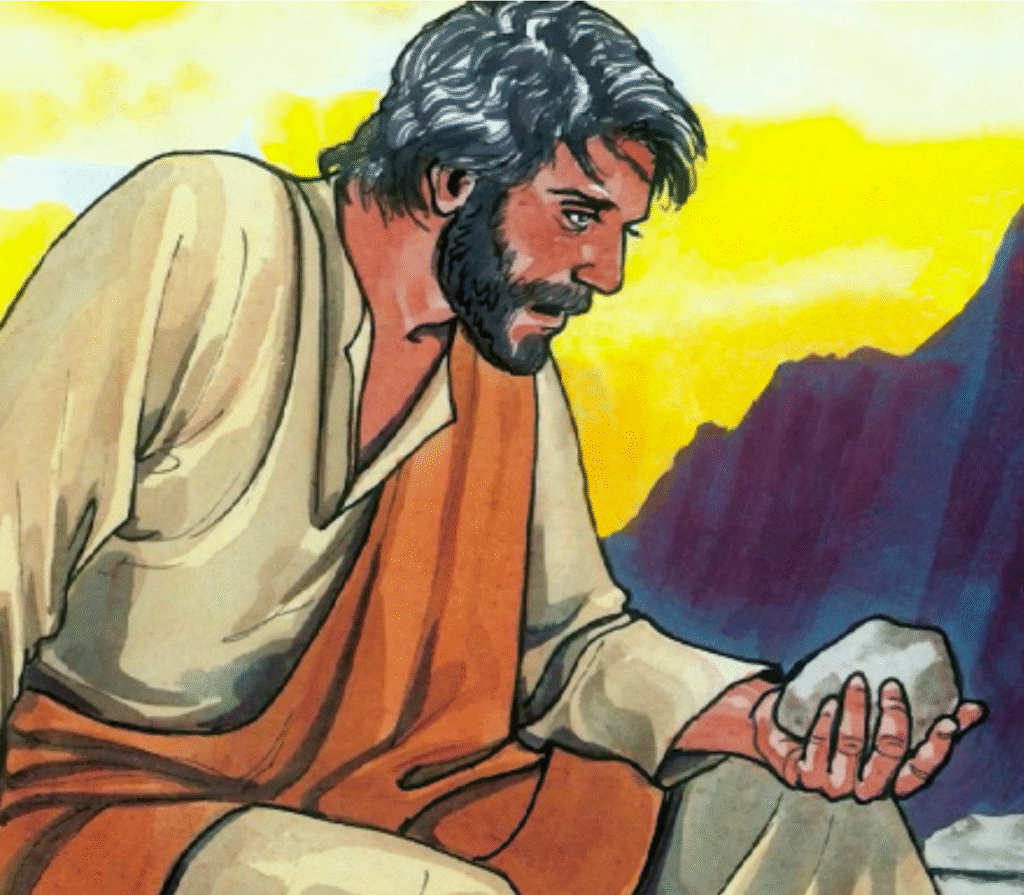
It’s understandable, that at the end of a forty-day fast, using one’s ability to turn stones into bread would be tempting. Under other circumstances this might not have been sinful, but performing this miracle was not how Jesus was to prove that He was the Son of God. In response, Jesus quoted Moses who reminded Israel how God had humbled them by allowing them to hunger in order to teach them that “man shall not live by bread alone; but man lives by every word that proceeds from the mouth of God” (Deut. 8:3).
One thing we can learn from this temptation is that Satan is devious enough to use a natural human desire to tempt us to do evil. He will try to convince us that because the desire is legitimate, we have a right to satisfy it anyway we can. We learn from Jesus’ response that we should listen to the word of God instead of being directed solely by our fleshly desires. In the event of hunger, God’s word teaches us to work in order to satisfy this lust (Eph. 4:28).
Hunger is not the only natural fleshly desire that Satan will tempt us to satisfy illegitimately. Sexual desire is one of his most powerful enticements, and he has convinced much of humanity that they have “a right” to satisfy it as they please. God’s word teaches us that “Marriage is honorable among all, and the bed undefiled; but fornicators and adulterers God will judge” (Heb. 13:4).
Luke’s account then has Satan taking Jesus upon a high mountain to see “all the kingdoms of the world in a moment of time” (4:5). Matthew described this mountain as “exceedingly high” (4:8). There Satan offers Jesus what Satan thought would be irresistible: “If You will worship before me, all will be Yours” (Lk. 4:7). It had to be a glorious sight; but, resisting the lust of the eyes, Jesus preached God’s word to Satan: “It is written, ‘You shall worship the Lord your God, and Him only you shall serve’” (Deut. 6:13; 10:13).
Satan isn’t likely to use the lust of our eyes to promise world domination, but he will put before our eyes whatever appeals to us if only we will bow to him. We would do well to remember that when Achan “saw a beautiful Babylonian garment, two hundred shekels of silver, and a wedge of gold,” he was led to coveting and taking what was accursed (Josh. 7:21).
Following the order of temptations given in Luke’s account, Satan’s final effort to trip Jesus up involved taking Him to a high place of the temple and challenging Him, “If You are the Son of God, throw Yourself down from here” (4:9). Satan even resorted to quoting Scripture promising God’s protection (Psa. 91:11-12). But Jesus recognized that Satan was trying to entice Him to test whether God would acknowledge His Son by saving Him from such a fall. Jesus’ response: “It has been said, ‘You shall not tempt the Lord your God’” (Deut. 6:16).
We need to be aware that Satan has “his ministers” who portray themselves “as ministers of righteousness” (2 Cor. 11:15) who will even quote from the Bible in order to teach what the Scriptures do not teach. They may be in pulpits or theological seminaries, twisting not only the apostle Paul’s epistles, “in which are some things hard to understand,” but also “the rest of the Scriptures” (2 Pet 3:16). Perhaps the most significant thing we should understand from Satan’s attempt to entice Jesus to sin is that the Son of God was not Satan’s ultimate target. Had he succeeded, Satan would have accomplished his main mission—the inescapable bondage to sin of all mankind, resulting in our “everlasting destruction from the presence of the Lord” (2 Thess.1:9)
The Relationship Between Grace, Faith & Works
Bored With Bread
Responsibility to the Body
Life-Cycles
The philosopher in Ecclesiastes observes, “To everything there is a season, a time for every purpose under heaven: a time to be born, and a time to die; a time to plant, and a time to pluck what is planted,” etc. (3:1,2). Likewise, the Hebrews author soberly writes that “it is appointed for men to die once, but after this the judgment” (9:27).
As we age, we become more acutely aware of the reality that we will not live in these failing bodies forever. Just as surely as babies continue to be born, more and more people we know depart this life. Birth and death bookend the life-cycle for all of us. It is the way of our present condition in this present world.
However, the reality of the end of life as we know it need not be hopeless. Indeed, of all people, we who believe that Jesus Christ is the risen Son of God and follow Him should be the most at ease with “a time to die.”
Life is a series of beginnings and endings; with many of these life-cycles comes some natural discomfort in the ending of anything and the uncertainty of what will follow. Whether we are graduating from school, moving out on our own, getting married, changing jobs, retiring, or losing a spouse, there is apprehension about what might come next and how we will cope.
This observation about life-cycles is true for churches as well. While the church that Jesus promised to build would be unfazed by “the gates of Hades” (Matt. 16:18), local groups of Christians have come and gone over the last two millennia. The one body of Christ continues to grow, and the membership of those added to it by the Lord is unaffected by their physical deaths. Yet, we see that local churches that were once vibrant can very much be affected by death and may dwindle into obscurity.
While some may think this observation depressing, it is a reality that is quite obvious to any reader of Scripture. Whatever happened to the many churches we read about in the New Testament?
Paul worked hard to spread the gospel and establish churches throughout the Roman Empire, but some may wonder to what avail he labored seeing that not one of those churches exists today. Where are the seven churches of Asia to which Jesus instructed John write? All of these early churches (including the one in Jerusalem) had varying life-cycles and eventually succumbed to the inevitable demise that comes to all people (and groups of people) in this world.
Does this reality mean that Christ’s church has failed? God forbid! While earthly churches and those who comprise them have life-cycles, the body of Christ the eternal One does not.
Therefore, let all saints remember that neither the end of their lives nor the end of their local churches is a reason for despair. While it is right that we press on with diligence in this life while we have the strength to do so, we need not conclude that the end of a cycle of life in this realm equals failure. The philosopher cryptically observed, “The end of a thing is better than its beginning” (Eccl. 7:8). In Christ, the end of a thing is the beginning of something greater (cf. Phil. 1:23).