

From the Archive:

The Believer’s Valley Experience
Images of valleys are often used to symbolize struggles in life, while mountain peaks serve as symbols of victory. In the Old Testament, valleys were sometimes locations of battles or of God’s judgment (Joel 3:14). In Psalm 23 David speaks of walking “in the valley of the shadow of death” (v 4). Even today we sometimes refer to times of trouble or discouragement as valleys we are going through.
It is safe to say that all people, no matter who they are, face times of discouragement in this life. Even among the “greats” of God’s messengers, we see evidence of periods of discouragement.
• Noah, a “preacher of righteousness” for over 100 years, undoubtedly was not encouraged by the destruction of the rest of mankind as his “congregation” of eight souls floated away.
• Abraham, even as he climbed a mountain to obey God by sacrificing his son, had to be in an emotional valley (Gen. 22).
• Moses faced opposition from the very people he was leading out of bondage and sometimes felt the burden was too much to bear (Num. 11:11-15).
• Elijah thought at one point he was the only one in Israel concerned with pleasing God (1 Ki. 19:10).
• The apostle Paul, normally very upbeat, reported that at one point he “despaired even of life” (2 Cor. 1:8).
We are told that “all who desire to live godly in Christ Jesus will suffer persecution” (2 Tim. 3:12). So it should not be a surprise to find faithful Christians today who experience “valleys” due to circumstances in life.
There may be times when we may not understand why God is letting us walk in a valley. Consider Job, whom God said was “blameless and upright, and one who feared God and shunned evil” (Job 1:1). He clearly didn’t understand why God was permitting him to suffer. In our minds we say, “God is with us,” but from our emotions we feel, “God, where are You when we need You?”
Some valleys are deeper than others and may take more effort to climb out of, but with God’s help, we can. Understand, the valley is not the place where God intends for us to take up residence. We must walk through it—not make it our home.
Just because God allows us to be in a valley doesn’t necessarily mean that He is responsible for putting us there—unless He puts us there in order to teach us.
Some find themselves in a valley because they don’t listen to God (example: Jonah). Others can’t get out of a valley because of unrepentant sin. Some may be there because of the sins of others (i.e. family troubles, an unrighteous nation, etc.). And still others may be there due to “natural causes” (i.e. disasters or maybe even a pandemic).
God uses our valley experiences to instruct us. The apostle Paul gave us three “benefits” that are gained from facing trials (2 Cor. 1:3-11):
1) We will be able to comfort others (v.6);
2) We will develop patient endurance; and
3) We will trust in God and not in ourselves.
Jeremiah wrote, “Blessed is the man who trusts in the Lord” (17:7).
Realizing that it is more than likely that we will have valley experiences, let’s look at what we should do while there.
▶ Praise God for what He has done for you. “Blessed be the God and Father of our Lord Jesus Christ, who has blessed us with every spiritual blessing in heavenly places in Christ” (Eph. 1:3). Our sins have been forgiven! Jesus is pleading our case.
▶ Praise God for what He will do for you. “Blessed be the God and Father of our Lord Jesus Christ, who according to His abundant mercy has begotten us again to a living hope through the resurrection of Jesus Christ from the dead…” (1 Pet. 1:3). Because of Jesus’ resurrection, we have the realistic expectation (hope) of our own resurrection from the dead.
▶ Praise God for what He now does for you. “Blessed be the God and Father of our Lord Jesus Christ, the Father of mercies and God of all comfort” (2 Cor. 1:3). He is there “in all our tribulation” (v.4). And when thing are going wrong, “we know that all things work together for good to those who love God, to those who are called according to His purpose” (Rom. 8:28).
We have a God who “knows how to deliver the godly out of temptations…” (2 Pet. 2:9). He may not deliver his saints immediately—or even in the same way. The apostle James (one of the “sons of thunder”) was delivered from his trials by death. The apostle Peter, under the same threat, was delivered from prison. Sometimes God delivers us from trials, and at other times He delivers us through trials.
God uses other Christians to help us face trials. When we are able to endure trials we are more equipped to help those who are still in the valley. We are asked to “pass it forward.”
Remember, when you are in the valley, you’re still safe because God has promised, “I will never leave you nor forsake you” (Heb. 13:5). But let’s not take up residence in the valley. That’s not what God intends for us.
aldiestel@gmail.com

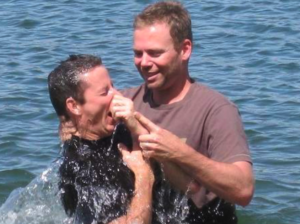
Uncontroversial Baptism
There was much controversy surrounding Jesus Christ in the first century, and there remains much controversy in the 21st century. Essentially controversies are disagreements, and we see them in all realms of life. They are not unique to religions. Yet, we should expect controversies in matters of faith because there will always be believers and unbelievers. If faith has any meaning at all, then it must be a matter of some controversy.
Of course, the controversies range all over between believers and unbelievers as well as between believers and believers. Jesus was and is a controversial person of history. Jesus often found himself in the midst of controversies with the religious leaders of His day. His claims were controversial. To avoid all controversy is to avoid Jesus. Some people enjoy controversy and others avoid it for a variety of reasons, but neither the enjoyment nor the avoidance of controversy are Christ-like.
The earliest of Jesus’ followers were not immune to controversy even among themselves from time to time. From the petty discussions of Jesus’ apostles about which of them was the greatest to the much more significant matters related to converting Gentiles to Christ, from the sharp disagreement between Paul and Barnabas over John Mark to the much more consequential issue of the Word becoming flesh, controversy in some form was ever-present. However, it is also interesting to consider something that does not appear to have been a matter of controversy in Scripture but is a matter of controversy among professing believers today…baptism. Of course, there is much to consider on the subject of baptism because it is spoken about so frequently in the New Testament, but our focus will be on some positive affirmations made about baptism and its connections to Jesus Christ.
Jesus’ own words (following His resurrection and just prior to His ascension back to heaven) emphasize baptism in making disciples of all nations (Matt. 28:19). The book of Acts makes it clear that the first preachers of the gospel did what Jesus asked them to do in making disciples.
In the very first gospel sermon, Peter affirmed the resurrection of Jesus from the dead and His subsequent outpouring of the Holy Spirit. The awful realization (of some who believed the apostolic witness) that they were guilty of crucifying their Messiah prompted the plaintive cry of “What shall we do?” Peter’s reply informed them (and us) of the necessary response. Note this well—Peter taught that both the remission of sins and the gift of the Holy Spirit belong to those who repent and are baptized in the name of Jesus (Acts 2:38).
When he encountered the Ethiopian eunuch, Philip began where the Ethiopian was reading (i.e. Isaiah 53) and “preached Jesus to him.” That’s all we are told before the Ethiopian observed water and asked to be baptized (Acts 8:35,36). Preaching Jesus to the uninitiated should have those who desire to follow Jesus asking to be baptized. Why? Where would they get that idea? Baptism is fundamental to preaching Jesus as the crucified but risen Lord. This is made clear in Jesus’ own instructions to make disciples and in reply to the first penitent cry of “What shall we do?”
When Saul of Tarsus met Jesus on the road to Damascus, Jesus told the blinded persecutor to enter the city where he would be told what he should do. In the account of Acts 9 we are not told all that Ananias said, but what is emphasized is that he had come that Saul might receive his sight and be filled with the Holy Spirit (v 17). The narrator’s parallel in the following verse is enlightening. “He received his sight at once and he arose and was baptized” (v 18). In another account, we learn that Ananias prodded Saul to “Arise and be baptized and wash away [his] sins calling on the name of the Lord” (22:16).
There are other examples which might be cited to show the role and significance of baptism as instructed by Jesus and His apostles and prophets. However, what I want us to see is that there was no controversy about the place of baptism among the first Christians. Indeed, in none of Paul’s letters does he attempt to convince people of their need to be baptized. Consistently, Paul’s references to baptism in his letters are reminders of what all had already done. There was no controversy over baptism as there was about circumcision (e.g. whether or not it was necessary, required, essential).
To demonstrate the unanimity of thought about baptism among the earliest Christians, consider Paul’s observations in his letter to the Roman saints. In that letter, he is clearly addressing matters of some controversy with regard to justification by faith versus justification by the works of the law. In that context, Paul sought to answer those who maligned the gospel he preached. (It appears that Paul’s detractors parodied his preaching of justification by faith by suggesting that if what Paul taught was true, one might as well continue in sin so that God’s grace could abound all the more.) To answer this matter of controversy, Paul pointed to what they all had in common—they had all been baptized into Jesus (Rom. 6:1ff). Baptism is used by Paul as an uncontroversial point of common ground to address a matter of controversy. Baptism is presented as being into Christ and into His death. It is a type of the crucifixion of self, dying to sin, burying the old man, and rising to walk in newness of life. There weren’t some saints who were baptized and some who were not. This is what they all had in common, and it is on this basis of baptism that Paul reasons that grace is clearly not a license to sin.
Because of baptism’s association with Jesus Christ, our forgiveness of sins and new life, and its placement in his argument of salvation by grace versus law, it is clear that Paul considered baptism wholly a matter of grace and faith. (The very same point is also demonstrated in Galatians 3:24-27.) Why then, two thousand years later, is baptism a matter of controversy and relegated by some as a matter of works versus grace? Because some have embraced doctrines which are foreign to and/or inconsistent with the gospel of Jesus Christ.
In summary, Paul associated baptism with grace and faith and described it as being into Christ and into His death. Paul’s letters to Christians were not written to convince them of their need for baptism. This was assumed because baptism was so foundational to the preaching of the gospel of Jesus Christ from the very beginning. There were controversies that had to be dealt with among the first Christians, but baptism into Christ was not one of them. Paul did not write to warn against those who taught that baptism was for the remission of sins. This is because baptism into Christ was for the remission of sins, and this was accepted by all. Baptism into Christ was commonly accepted as a matter of faith in Jesus Christ and as accessing God’s grace because baptism was seen—not as a means of justification by law or works—but as God’s gracious offer to justify us by faith.
andydiestelkamp@gmail.com

I Can’t Command… So I Plead (Articles From the Days Gone By)
If I could be given the power to command, to force, to require, then I would demand of God’s people and other people of America, good homes. I do not speak now of houses— whether they be shacks by the side of the road or mansions on a hill. But I speak of homes—family circumstances and associations. And since it is impossible to enforce a command for good homes, I must beg, plead, and exhort.
I plead for homes where there is love, peace, tranquility, serenity, and hope. I plead for homes where there is unity, mutual respect, morality, happiness, and optimistic enthusiasm. I plead for homes were hatred, malice, bitterness, selfishness, and vengeance are excluded. I plead for homes where dope, wine, beer, whiskey, divorce, fornication, adultery, and profanity are totally absent.
I prayed for homes as God intended for them to be – the cradle of civilization, the bulwark of the church and the vestibule of heaven. And I do not plead for the impossible, but for the kind of homes that we can indeed have – if we will. Perhaps less emphasis should be put upon up-to-date ways and means of having good homes, and more emphasis is needed upon commitment, dedication, determination, desire, devotion and responsibility, for if we have these qualities, we will usually find the ways and means for success.
A Wounded Land
The Lord said to Solomon, “If my people which are called by my name, shall humble themselves, and pray, and seek my face, and turn from their wicked ways; then I will hear from heaven and will forgive their sins, and will heal their land” (2 Chron. 7:14). And, oh, today our land needs healing! Ours is a sick society, a troubled nation, a wounded land! And in the midst of all this, God’s churches suffer, for the churches are people, and people represent homes, and too many homes are not good homes.
The nation and the churches are both wounded by permissive parents, by doting grandparents, and by liberal teachers who fill tender minds with humanistic trash. We, as a people, are wounded by disobedient children and by rebellious youth. We are wounded by disregard for marriage, by unconcern for chastity, by broken families, and by promiscuousness, and by amorality among adolescents, teenagers, and adults.
Is There No Healing Balm?
When Jeremiah observed “the graven images in the strange vanities” of God’s people, he cried out, “The harvest is passed, the summer is ended, and we are not saved… is there no balm in Gilead; is there no physician there?” Indeed, Jeremiah knew and the people knew that God’s Word and God’s ways would heal the land. His question was rhetorical. He was appealing to them to return to God’s will and way. Today I cannot appeal to the nation we call America for I have no sufficient voice to reach the nation. But today I appeal to those of God’s people who may hear me. God will hear our prayers, he will bless his people, he will make us a great and shining light in the world when the sound words we hear from our pulpits are applied in our homes, demonstrated in our lives, and exemplified by husbands and wives, fathers and mothers, sons and daughters.
God may heal our land and bless His church today if His people will commit themselves to “family righteousness.” The fable is told that when a chasm opened in the Forum of Rome, it was said by the Oracles that whatever was most precious in Rome must go into the chasm to close it. And a soldier, with his armor and mounted on his horse, spurred the horse into the chasm after which act of valor the conscience of the earth closed over him. In 1861, in a speech in the Senate, Timothy Hall of Wisconsin, typified Abraham Lincoln as plunging himself into the dark chasm that was about to destroy the nation. Today a vast and deep chasm may be about to engulf the land and the churches. It is for us, as Christians, to exhibit the courage and fidelity that will bring reformation – that will close the chasm—by producing the good homes that will be the cradle of civilization, the bulwark of the church, and the vestibule of heaven.
This article was first appeared in Think, Vol. 13, No.1, dated Jan-Feb-Mar, 1982
Being Wise About Wisdom
Although people may choose to accept it, twist it, or reject it, the revealed wisdom of God is straightforward with its message of holiness, love, mercy, forgiveness, and godly living (ex: Ja 3:17). The wisdom of the world is generally straightforward with its carnality, hate, selfishness, and immorality (Ex: Ja 3:14-17)—though the world advertises those positively. But there is a third wisdom which has actually become far more controversial because it uses human experience to apply God’s wisdom.
God’s wisdom is primarily revealed information. Learning and understanding God’s wisdom is necessary but isn’t wisdom itself. Even accepting His revealed wisdom as truth does not mean one is wise. Wisdom involves learning, understanding, and accepting God’s wisdom, but to be wise, one must apply it. Specific application of God’s wisdom to daily living is not always spelled out in Scripture. This is where men and women with spiritual minds taught by God’s wisdom use what they see and learn about life to make actual life choice applications.
James tells us that “…the wisdom that is from above is first pure, then peaceable, gentle, willing to yield, full of mercy and good fruits, without partiality and without hypocrisy” (3:17); but he doesn’t tell us what that looks like in every situation we will face. Paul tells us that there are obvious acts of the flesh, but there are additionally “such things” that are not specified which the wise will identify and avoid. This is the “senses exercised” to which the Hebrews writer refers (He 5:14). It means knowing more Scriptures but also involves learning how to use and apply the Scriptures to “discern both good and evil” in daily, complex, and modern living.
Job said, “Wisdom is with aged men, and with length of days, understanding” (Jb 12:12). Ideally they will have had time to learn God’s revealed will and to use a wealth of human experience to perceive how to apply God’s wisdom to many aspects of life. This takes time. This takes observation. This takes learning from failures and successes (their own and those of others). There is a strong temptation to argue with this kind of wisdom. It is an application of God’s wisdom, but not a direct quote of Scripture, so it can be easier to reject. This wisdom is sometimes deflected or even rejected by saying, “You say it’s unwise, but you can’t show Scripture that specifically says it is unwise or sin.” Admittedly, saying something is wise or unwise can be a lazy way to preserve traditions or resist re-examining convictions. But well-reasoned wisdom from those who are godly, mature, and spiritually minded needs to be carefully considered even though it may have been abused by others. “Whoever walks with the wise becomes wise, but the companion of fools will suffer harm” (Pr 13:20)
davdiestel@yahoo.com
Waking to a ‘Woke’ World
I confess that when I first started hearing people use the word “woke” in ways that were unfamiliar to me, I was confused. I would hear people say things like, “I think you should be more woke,” or “I’m working on being more woke.” I thought I knew the meaning of the word, but it was obvious that people were using it in a different way.
Realizing that words can have more than one meaning I went to my trusty dictionary—Webster’s New World Dictionary of the American Language—that was purchased when I was in high school. Sure enough, the definition was as I thought it would be: “alternate past tense of wake.” Then I wondered if this 66 year-old dictionary is out of date, so I grabbed my Merriam-Webster’s Collegiate Dictionary, Tenth Edition that was published in 1993. However, it agreed with the older one. Having no more dictionaries in my house, I went to the Internet and found several definitions such as “Spiritual and intellectual enlightenment, like waking up from a deep sleep and seeing things clearly for the first time” [urbandictionary.com].
On the surface, that sounds like a good thing and is even in harmony with scriptural admonitions in Paul’s letters: “And do this, knowing the time, that now it is high time to awake out of sleep; for now our salvation is nearer than when we first believed” (Rom. 13:11); also “Awake to righteousness and do not sin, for some do not have the knowledge of God…” (1 Cor. 15:34). However, like many other good objectives, the need to “wake up” has been co-opted and perverted by advocates of certain social, moral, and religious changes from biblical standards.
It has always been a goal of Satan to convince people to abandon and reject God’s call to righteousness. He has been consistent in his attempts to convince mankind to do away with any adherence to righteous living, and the “woke” approach is just one of his latest ploys. Unfortunately, it seems to be working for him with a great percentage of the world and even with some professing Christians.
Satan is patient, and the gradual erosion of morality has been evident. The so-called sexual revolution in the 1960’s and women’s liberation movement that began about the same time had success in making divorce, fornication, and adultery common and acceptable. These have paved the way for the more recent endorsement and promotion of homosexuality and other perversions. And don’t think for a moment that Satan will be satisfied before and until the world accepts consensual pedophilia as “normal” for those so inclined.
The fear of not being viewed as “woke” has caused many advertisers of products and producers of entertainment to actually promote sexual perversion. Even so-called “conservative” media has bowed to woke pressure by featuring guests and network contributors that openly admit to being homosexual or transgender. The more sexual perversions are portrayed or treated as being “normal,” the more likely society will endorse those practices as personal choices and will accuse anyone who believes them to be sinful as being a bigot. As the Lord’s people, we must be prepared to be maligned and ridiculed due to our stand for truth and righteousness that has been revealed in the Word of God—our ultimate standard.

aldiestel@gmail.com
Awake, you who sleep,
Arise from the dead,
And Christ will give you light.
EPHESIANS 5:14